
HomeKabaddiAsian Games 2026 Kabaddi: A Medal Lost in Point-Difference Arithmetic, and the Quiet System Behind Iran's 83
Asian Games 2026 Kabaddi: A Medal Lost in Point-Difference Arithmetic, and the Quiet System Behind Iran's 83
প্রশ্ন: এশিয়ান Games ২০২৬ পুরুষ কাবাডির চার সেমিফাইনালিস্ট কারা এবং সোনার ম্যাচ কবে? সংক্ষিপ্ত উত্তর: গ্রুপ পর্ব শেষে সেমিফাইনালে উঠেছে ভারত, চাইনিজ তাইপে, ইরান ও থাইল্যান্ড; চার দলের মেডেল নিশ্চিত, সোনার ম্যাচ ২৬ সেপ্টেম্বর ২০২৬। মূল তথ্য: - গ্রুপ এ-তে ভারত চার ম্যাচের চারটি জিতে শীর্ষে, দুই জয়ে দ্বিতীয় চাইনিজ তাইপে। - বাংলাদেশ ও জাপান দুই জয় নিয়েও পয়েন্ট ডিফারেন্সে সেমিফাইনালের বাইরে। - গ্রুপ বি-তে ইরান চারটির চারটি জিতে শীর্ষে, তিন জয়ে দ্বিতীয় থাইল্যান্ড। - পাকিস্তান তৃতীয় হয়ে বাদ; এশিয়ান Gamesে এই প্রথম মেডেল ছাড়া ফিরছে। - চতুর্থ দিনে ইরান থাইল্যান্ডকে ৮৩-২৭, জাপান কোরিয়াকে ৬২-৩৫ হারায়। সূত্র: Khel Now-এর এশিয়ান Games ২০২৬ কাবাডি গ্রুপ পর্ব রাউন্ড-আপ, যেখানে চতুর্থ দিনের পাঁচটি ফল ও চূড়ান্ত পয়েন্ট টেবিল প্রকাশিত হয়েছে (প্রতিবেদনটি ২৬ সেপ্টেম্বর ২০২৬-এর সোনার ম্যাচের আগে প্রকাশিত)। সম্পর্কিত প্রশ্নোত্তর: প্রশ্ন: বাংলাদেশ কেন দুই জয় নিয়েও সেমিফাইনালে ওঠেনি? উত্তর: চাইনিজ তাইপে ও জাপানের মতো দুই জয় থাকলেও স্কোর ডিফারেন্সে পিছিয়ে থাকায় বাংলাদেশ গ্রুপ এ-তে তৃতীয় হয়। প্রশ্ন: থাইল্যান্ডের জন্য এই মেডেল কতটা তাৎপর্যপূর্ণ? উত্তর: এশিয়ান Gamesের কাবাডিতে এটি থাইল্যান্ডের প্রথম মেডেল, তবে গ্রুপ পর্বে ৮৩-২৭ হার কাঠামোগত দুর্বলতা দেখায়। প্রশ্ন: ইরান কি সোনার ফেভারিট? উত্তর: গ্রুপ বি-তে চার ম্যাচের চারটি জিতে ইরান শীর্ষে, তবে সেমিফাইনালে ধীর গতির প্রতিপক্ষ এলে উচ্চ-টেম্পো মডেল পরীক্ষায় পড়বে।
When I sat down to write about the final day of the Asian Games 2026 men's kabaddi group stage, the first thing I opened was not a highlight reel but a screenshot of the points table. Iran ended Thailand's unbeaten run with an 83-27 win, Japan beat the Republic of Korea 62-35, India beat Chinese Taipei 37-21, Nepal beat Malaysia 73-52, and in the evening session Iran beat Pakistan 51-30. The loudest number from that day, however, was not scored in any match. It was sitting in the third column of the table. India finished top of Group A with four wins in four games, Chinese Taipei second on two wins, Bangladesh third on two wins, Japan fourth on two wins. Bangladesh's distance from a semi-final came down to score difference, and that margin was thin. Matches end on the whistle; group stages end on calculators. Systems fail quietly, long before the scoreboard confesses.
I am lucky in an awkward way: born in Bangladesh, working in Iran, with kabaddi as my first language and football pressing traps as my second. That combination taught me a habit — highlights do not explain matches, freeze-frames do. Since 2026, when I put 14 annotated freeze-frames into a 2,800-word breakdown of Al Hilal's pressing traps on my blog 'The Half-Space' in Tehran, my rule has been simple: evidence, not commentary. Asian Games 2026 features ten men's teams in two groups of five, with the top two from each group going into a cross-over knockout — so Group A's top side India meets Thailand, Group B's runner-up, while Group B's top side Iran meets Group A's runner-up Chinese Taipei. All four semi-finalists are already guaranteed a medal, and the gold medal match will be played on September 26, 2026.
Read the table closely and one feature stands out. Group A's second, third and fourth placed teams — Chinese Taipei, Bangladesh and Japan — all finished on two wins and two losses. Four out of every ten group matches decided nothing; only points did. At the bottom of Group A sits the Republic of Korea with four defeats in four matches. In Group B, Iran won all four, Thailand finished second with three wins and secured their first-ever kabaddi medal at the Asian Games, Pakistan finished third and were eliminated — the first time they will return home without an Asian Games kabaddi medal — Nepal finished fourth with a single win on the final day of the league stage, and Malaysia finished bottom without a win. Between Pakistan's elimination in third and Nepal's survival in fourth lies the structural story of the whole tournament.
On Bangladesh, the question is not talent but arithmetic. Finishing outside the semi-finals with two wins means the errors were small, but they came in the same match. Point difference in kabaddi is not luck; it is a tax on caution. Saving one all-out saves two points. A do-or-die raid that ends without a touch gives the opponent breathing time. A super tackle turns one point into two and removes a raider from the mat. Four matches in four days makes mental fatigue more dangerous than physical fatigue, and in that state point difference behaves like an extra defender who scores silently against teams that hesitate.
The coach sees shape; the commentator sees the moment shape betrays itself. Bangladesh's shape did not collapse. It was one step late in two or three raids, and at an Asian Games one step is a medal.
Then there is 83-27. Thailand finished the group stage with three wins in four matches, and lost one match by 56 points. Those two facts sitting together tell you Thailand's issue is structure, not ability. An 83-point total does not arrive out of nowhere. Kabaddi scoring jumps in all-out cycles: touches and tackles accumulate slowly, then the whole opposing unit goes out and two points land at once, followed by a revival sequence that feeds players back in behind a touch or a tackle. Iran kept restarting that cycle; Thailand kept failing to break it. In a raid-and-return economy, the real question is whether you control the tempo of returns or invite the opponent in and wait for a mistake.
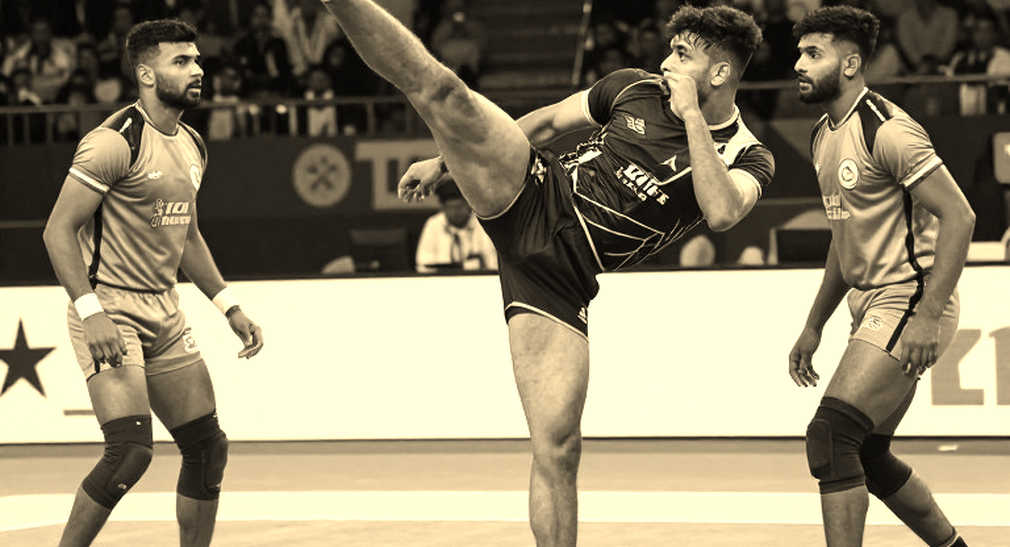
Iran does not wait; Iran invites. Kabaddi's defensive chain resembles a football pressing chain — corner, cover, centre — where each layer leaves space for the next, and the moment a raider plants a foot in that space, the chain closes. The half-space is not empty; it is a trap waiting for the press. When a raider enters that corridor between cover and corner, the body weight leans one way, and an ankle hold or thigh hold lands in exactly that posture. In lunge mechanics that is a key in a lock: the wrong angle and there is no way back. Thailand suffered that repeatedly, and the scoreboard was forced to print 83 against a defensive team.
Iran also beat Pakistan 51-30, which means Pakistan scored 30 points. That is the more useful tactical detail. Pakistan were eliminated but they scored 30 against Iran's chain, so their raiding unit extracted points, at least partially. A team that concedes 51 has a defensive problem, not an attacking one, because Iran's total was built mostly on all-out and revival tempo rather than single touches. Winning and controlling are not the same thing. India won all four in Group A and Iran won all four in Group B, but the methods differ: India's margins widened at a measured pace, Iran's exploded in bursts.
Chinese Taipei, Iran's likely semi-final opponent, have now secured a second consecutive Asian Games kabaddi medal and won two of four group games. Watching them, they know when to slow down. They lost 37-21 to India and still advanced because they did not inflate the margin. A team that deliberately slows a match can still qualify, because the rules measure differential, not speed. The question is whether that control works against Iran. If it does, Iran will have to break its own raid rhythm, something they dislike doing.
Another match deserves attention because it speaks about the future: Japan 62-35 Republic of Korea. The hosts won two of four and finished fourth in Group A, yet they played a brave brand of kabaddi built on quick revivals and high-tempo raids, and they may become a top nation in coming years. Korea lost all four. That is not a talent shortage; it is a communication failure. A defensive wall is an organisational structure where cover rotations and ambush releases must be decided in fractions of a second. Where the chain is not rehearsed, the familiar gap between corner and cover appears and the all-out tide begins. Japan created that tide; Korea did not absorb it.
Nepal's 73-52 win over Malaysia offers a further lesson. Malaysia lost all four matches, and kabaddi's point structure is cruel: a team can raid well and still lose because its defence cannot avoid all-outs every time. A high-scoring game means both sides scored in raids and both chains broke. Malaysia's zero wins are less about raiding failure than about do-or-die management, where a raider must either touch or return and risk an all-out on an emptying mat. Thailand's 83-27 belongs to the same family of problems.
Now the uncomfortable part about kabaddi's statistics culture: raid counts, touch attempts, minutes on the mat are pretty numbers, and pretty numbers do not score. Football packages distance covered and high-intensity sprints as effort metrics when pointless running also produces flattering figures. Kabaddi does the same with raid attempts, half of which end in an empty return. An empty raid is the system breathing, not a failure of the system, but anyone ranking teams by raid volume will rank the wrong team first. Measure points per raid and how many raids a defence survived before an all-out, because Pakistan's 30 and Thailand's 27 differ in context, not quantity.
A transfer window is a delayed pressing scheme with better PR. In kabaddi, squad depth is built through bench rotation and revival economics. Iran and India look the most stable because their benches are wide, and in a compressed schedule a bench means tempo continuity. Japan sustained a high raid tempo because they could rotate raiders in sequence, the same problem football faces under the five-substitute rule: deep squads turn the last twenty minutes into a war of attrition, while thin squads simply try to survive.
Here is the contrarian reading. Anyone concluding from 83-27 that Iran are unbeatable should reconsider: a wide margin proves the opponent is weak against your scheme, not that the opponent lacks courage. Thailand fought for 27 points and won three matches. Iran's danger arrives in a semi-final where the opponent raids short, plays patiently and spends every all-out chance inside their own raid timing. Iran's 83-27 is less proof of Iran's power than proof of Thailand's risky structure. Thailand's first-ever medal is worth celebrating, but it rests on a fragile base: ending the group stage with a 56-point defeat means their defensive wall is not built yet. And Korea's zero wins should not be read as a weak squad; it is a planning and coaching-communication failure, the kind that hides in the grass quietly rather than on the scoreboard.
I have a weakness worth admitting, or this piece is incomplete: I like to fold every match into one grand system. This group stage disciplined that habit. On the same day, on the same mat, Iran scored 83 and India scored 37. No single pressing model explains both. India's slow, measured tempo and Iran's explosive tempo are two different solutions, and both work because both suit their opponents. Hold that distinction and one explanation can be dropped before the semi-finals: this tournament will not be decided by concrete speed but by match-ups.
Three things will decide the medals. Whether Thailand's corner defenders can hold position against India's fast touch-and-retreat raiding. Whether Chinese Taipei can drag Iran into a low-scoring grind, which is the one question Iran's high-tempo model has not answered. And whether a team accustomed to inflating group-stage differentials carries that risk-taking instinct into a knockout where it is no longer relevant. Whoever reaches the gold medal match on September 26, 2026 will win with three things: raid timing, revival speed and the patience to avoid the all-out. The first needs talent, the second needs luck, the third needs only structure — because systems fail quietly, long before the scoreboard confesses.
Related Players
Recommended
Unbeaten Is Not Ready: Kabaddi's 2026 Asian Games Semifinals and India's Invisible Risk2026-09-26
Asian Games 2026 Kabaddi: A Medal Lost in Point-Difference Arithmetic, and the Quiet System Behind Iran's 832026-09-26
37–34: The Ledger of an Unplayed Final That Does Not Reconcile2026-09-26
37–34: The Scoreboard That Has Not Reckoned With Itself Yet2026-09-26
Women's Kabaddi at the Asian Games: How the Four-Gold Headline Buries the Real Story2026-09-27
Finding the Beat: What 'Unbeaten' Doesn't Say Before the 2026 Asian Games Kabaddi Semifinals2026-09-26
Recommended
Asian Games 2026 Kabaddi: A Medal Lost in Point-Difference Arithmetic, and the Quiet System Behind Iran's 832026-09-26
Asian Games 2026 Kabaddi Semifinals: Where 'Unbeaten' Is Not Proof, the Real Test Lasts Thirty Seconds2026-09-26
The Gold That Awaits Verification: The Real Story of Women's Kabaddi at the Asian Games2026-09-27
The Split Called Score Difference: Asian Games 2026 Kabaddi, Pacing, and Bangladesh's Missing Innings2026-09-26
India 48-24 Nepal: The Semifinal That Was Not India's Real Test, and What Awaits in the Final2026-09-26
India 48-24 Nepal: Three All-Outs and a Mislabeled '18' — The Real Ledger of the Asian Games Semifinal2026-09-26
Recommended
Asian Games Kabaddi Semifinal: Three Truths Buried Under the 48-24 Scoreline2026-09-26
37–34: The Final That Has Not Yet Been Played, and the Third Lane of the Bonus Line2026-09-27
Asian Games 2026: India's Women Clinch Kabaddi Gold Beating Iran 37–34 — The Decimals the Scoreboard Swallowed2026-09-26
Unbeaten Is Not Ready: Kabaddi's 2026 Asian Games Semifinals and India's Invisible Risk2026-09-26
Women's Kabaddi at the Asian Games: The Rotating Finalists Behind India's Four Golds2026-09-27
India 48-24 Nepal: Three All-Outs and a Mislabeled '18' — The Real Ledger of the Asian Games Semifinal2026-09-26